

2026. TAOG 台灣婦產科醫學會115年度學術研討會
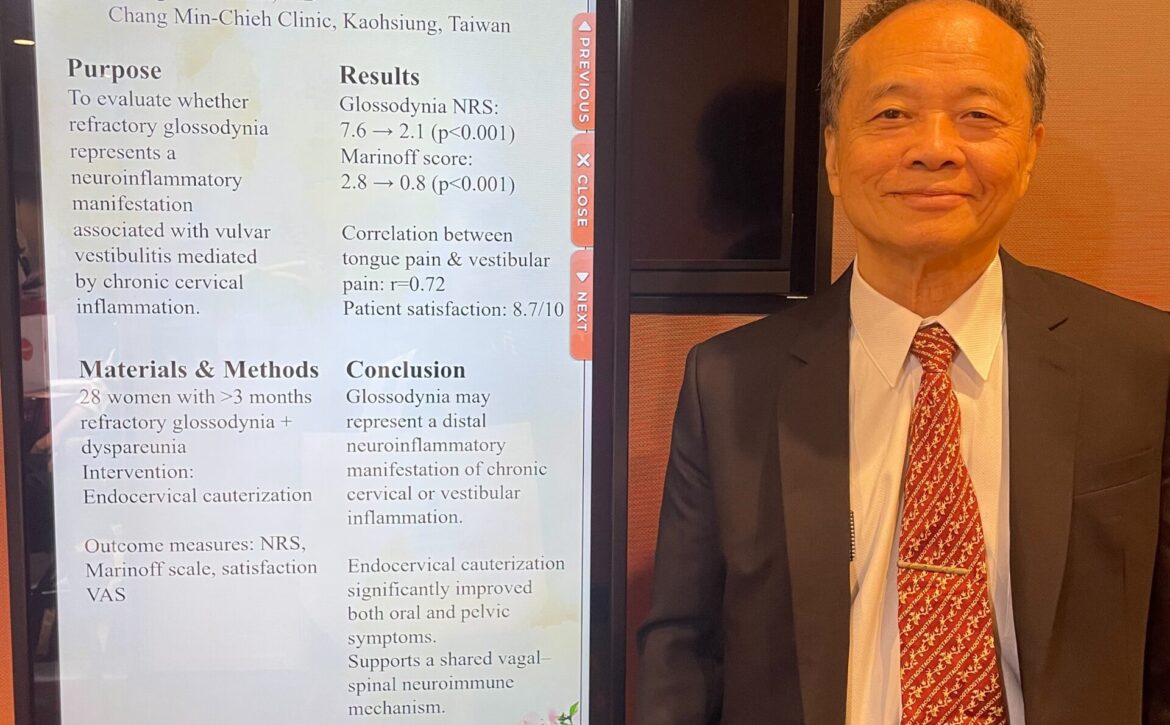
115.03.25-26論文發表:題目:難治性舌痛症合併外陰前庭炎:28例病例系列研究
張民傑 醫師
張民傑診所,高雄台灣
摘要(Abstract)
研究目的(Objective)
探討難治性舌痛症(口灼症,Burning Mouth Syndrome, BMS)與外陰前庭炎(Vulvar Vestibulitis, vestibulodynia)之間的潛在關聯,並評估這兩種看似不同的疼痛症候群是否透過迷走神經與脊髓神經的匯聚機制,共享一個神經發炎的病理途徑。
研究設計(Study Design)
本研究為回溯性觀察研究,納入28位女性患者(年齡29–68歲),其皆具有對傳統治療無效之慢性舌痛,並同時伴隨因慢性子宮頸炎或外陰前庭炎所致之性交疼痛(dyspareunia)。所有患者均接受內子宮頸電燒術作為主要治療。
疼痛評估採用數字評分量表(Numeric Rating Scale, NRS)與 Marinoff 性交疼痛分級量表,於治療前後進行比較。
研究結果(Results)
經子宮頸電燒治療後:
- 舌痛平均分數由 7.6 ± 1.8 降至 2.1 ± 1.2(p < 0.001)
- 性交疼痛由 Marinoff 分級 2.8 ± 0.6 降至 0.8 ± 0.4
- 病人滿意度平均為 8.7 / 10
此外,舌痛改善程度與前庭疼痛改善呈現顯著正相關(r = 0.72, p < 0.001)。
結論(Conclusion)
難治性舌痛症可能為一種由生殖道發炎經由迷走神經傳導所引發的遠端神經發炎表現。針對子宮頸或外陰前庭發炎進行治療,能顯著改善舌部疼痛,顯示外陰前庭炎與舌痛症之間可能存在共同的病理生理機制。
關鍵詞(Keywords)
舌痛症、外陰前庭炎、性交疼痛、迷走神經、神經發炎
前言(Introduction)
舌痛症(Glossodynia),亦稱口灼症(Burning Mouth Syndrome, BMS),是一種慢性口腔疼痛疾病,好發於停經後女性,通常缺乏可見的黏膜異常,且對傳統治療反應不佳。其病因尚未明確,目前認為可能與神經病理性疼痛及發炎機制有關。
外陰前庭炎(Vulvar Vestibulitis, VVD),又稱局部誘發型外陰前庭痛(localized provoked vestibulodynia),同樣以慢性疼痛與局部過敏為特徵。近期研究顯示,VVD可能屬於一種更廣泛的全身性神經發炎疾病,其特徵包括細胞激素上調及中樞敏化。
在臨床觀察中,我們發現許多難治性舌痛症患者同時合併前庭疼痛或性交疼痛,而這些症狀在治療慢性子宮頸發炎後可獲得改善。本研究提出,舌痛症與外陰前庭炎可能透過迷走神經與脊髓傳入路徑在延腦孤束核(NTS)進行匯聚,形成共同的神經免疫機制。
材料與方法(Materials and Methods)
研究對象(Study Population)
2017年至2025年間,共納入28位女性患者,皆具有以下條件:
- 慢性舌痛(超過3個月)
- 對牙科或神經科標準治療無效
- 合併性交疼痛
所有患者均於高雄張民傑診所接受治療。
排除條件包括:
- 全身性疾病(如糖尿病、貧血)
- 活動性口腔感染
- 精神疾病
治療方式(Intervention)
所有患者接受內子宮頸電燒術,以消除經陰道鏡與細胞學檢查確認之慢性子宮頸發炎病灶。
本研究未施行任何直接口腔或神經相關治療。
評估方式(Assessments)
- 疼痛評估:NRS(0–10)
- 性功能評估:Marinoff 性交疼痛分級
- 滿意度:0–10視覺類比量表
統計分析(Statistical Analysis)
使用配對 t 檢定比較治療前後差異,並以 Pearson 相關分析評估舌痛改善與性交疼痛改善之關聯性。統計顯著性定義為 p < 0.05。
研究結果(Results)
- 舌痛:NRS 由 7.6 降至 2.1(p < 0.001)
- 性交疼痛:Marinoff 由 2.8 降至 0.8(p < 0.001)
- 相關性:舌痛改善與前庭疼痛改善呈高度正相關(r = 0.72, p < 0.001)
- 滿意度:8.7 ± 1.1 / 10
討論(Discussion)
本研究顯示,慢性子宮頸發炎可能透過迷走神經傳入訊號,經由孤束核(NTS)與三叉神經系統的交互作用,誘發全身性神經發炎反應,並表現為遠端口腔疼痛。
舌痛症與外陰前庭炎的共存及其同步改善,支持「神經免疫匯聚假說(neuro-immune convergence hypothesis)」。
此外,子宮頸治療後細胞激素下降,進一步支持舌痛症並非局部口腔病變,而是系統性發炎環境所導致。
迷走神經同時支配子宮與咽喉—舌區,作為一條雙向免疫與感覺傳導通路,能調控局部與中樞發炎反應。
這也解釋了為何舌痛症常被誤診為心理性疾病:其真正來源並非口腔,而是來自骨盆器官的遠端神經發炎訊號。
結論(Conclusion)
難治性舌痛症可視為外陰前庭炎的一種神經共病表現,透過迷走神經與脊髓神經的神經發炎匯聚機制產生。
針對子宮頸或外陰前庭發炎進行治療,能顯著改善舌部疼痛,顯示兩者共享一個整合性的自律神經與免疫機制。
未來仍需透過神經影像學與細胞激素研究,進一步驗證此跨器官神經免疫交互作用。
Intractable Glossodynia Associated With Vulvar Vestibulitis: A Case Series of 28 Patients
Chang Min-Chieh, MD
Chang Min-Chieh Clinic, Kaohsiung, Taiwan
Abstract
Objective:
To investigate the potential relationship between intractable glossodynia (burning mouth syndrome) and vulvar vestibulitis (vestibulodynia), exploring whether these two seemingly distinct pain syndromes share a common neuroinflammatory pathway mediated by vagal–spinal neural convergence.
Study Design:
A retrospective observational study was conducted on 28 female patients (aged 29–68 years) who presented with chronic tongue pain refractory to conventional therapy and concurrent dyspareunia attributed to chronic cervicitis or vulvar vestibulitis. All underwent endocervical cauterization as the primary intervention. Pain scores were assessed using the Numeric Rating Scale (NRS) and Marinoff Dyspareunia Scale pre- and post-treatment.
Results:
Following cervical cauterization, mean tongue pain scores improved from 7.6 ± 1.8 to 2.1 ± 1.2 (p < 0.001). Dyspareunia improved from Marinoff grade 2.8 ± 0.6 to 0.8 ± 0.4. Patient satisfaction averaged 8.7/10. Improvement in glossodynia correlated positively with the degree of vestibular pain reduction (r = 0.72, p < 0.001).
Conclusion:
Intractable glossodynia may represent a distal manifestation of vagal-mediated neuroinflammation originating from the reproductive tract. Treatment targeting cervical or vestibular inflammation resulted in significant relief of tongue pain, suggesting a shared pathophysiological basis between vulvar vestibulitis and glossodynia.
Keywords: Glossodynia, Vulvar Vestibulitis, Dyspareunia, Vagus Nerve, Neuroinflammation
Introduction
Glossodynia (burning mouth syndrome, BMS) is a chronic oral pain disorder predominantly affecting postmenopausal women, often without visible mucosal abnormalities and resistant to conventional treatment. The etiology remains unclear, though neuropathic and inflammatory mechanisms have been proposed.
Vulvar vestibulitis (VVD), or localized provoked vestibulodynia, is likewise characterized by chronic pain and hypersensitivity of the vulvar vestibule. Increasing evidence suggests VVD is part of a broader systemic neuroinflammatory condition involving cytokine upregulation and central sensitization.
Our clinical observations indicated that many women with intractable glossodynia also suffer from vestibular pain or dyspareunia, both of which improve following treatment of chronic cervical inflammation. This study proposes a shared neuro-immune mechanism between glossodynia and VVD via dual vagal–spinal afferent convergence within the medullary solitary nucleus (NTS).
Materials and Methods
Study Population:
Between 2017 and 2025, 28 women who presented with chronic tongue pain (> 3 months) unresponsive to standard dental or neurologic therapy and concurrent dyspareunia were enrolled. All were treated at Chang Min-Chieh Clinic, Kaohsiung. Exclusion criteria included systemic diseases (diabetes, anemia), active oral infections, or psychiatric disorders.
Intervention:
Patients underwent endocervical cauterization to eliminate chronic cervical inflammatory foci previously confirmed by colposcopic findings and cytology. No direct oral or neural interventions were applied.
Assessments:
Pain intensity: NRS (0–10) for glossodynia and vestibular pain.
Sexual function: Marinoff Dyspareunia Scale.
Satisfaction: 0–10 visual analog scale.
Statistical Analysis:
Paired t-tests compared pre- and post-treatment data; correlations between tongue pain and dyspareunia improvement were analyzed by Pearson’s r. Significance was defined as p < 0.05.
Results:
Tongue Pain: Mean NRS decreased from 7.6 → 2.1 (p < 0.001).
Dyspareunia: Marinoff score improved from 2.8 → 0.8 (p < 0.001).
Correlation: Glossodynia improvement strongly correlated with vestibular pain reduction (r = 0.72, p < 0.001).
Patient satisfaction: 8.7 ± 1.1 / 10.
Discussion:
This study suggests that chronic cervical inflammation may trigger a systemic neuroinflammatory reflex via the vagal afferent–NTS–trigeminal complex axis, manifesting as distant oral pain. The co-occurrence and simultaneous improvement of glossodynia and vestibulitis support the neuro-immune convergence hypothesis.
Cytokine reduction following cervical treatment further indicates that the oral pain was secondary to a systemic inflammatory milieu rather than a localized lesion. The vagus nerve—innervating both uterine and pharyngeal–lingual regions—acts as a bidirectional immuno-sensory conduit, mediating both local and central inflammation.
This explains why glossodynia is frequently misdiagnosed as psychogenic: its origin lies not in the oral cavity but in remote neuroinflammatory signaling from the pelvic organs.
Conclusion:
Intractable glossodynia represents a neural comorbidity of vulvar vestibulitis through vagal–spinal neuroinflammatory convergence. Treating cervical or vestibular inflammation significantly reduces tongue pain, suggesting that the two conditions share an integrated autonomic and immune mechanism.
Further neuroimaging and cytokine studies are warranted to confirm this cross-organ neural–immune interaction.