

Burning Mouth Syndrome Associated with Vestibulodynia: A Case Series of 28 Patients Suggesting a Neuroimmune Link
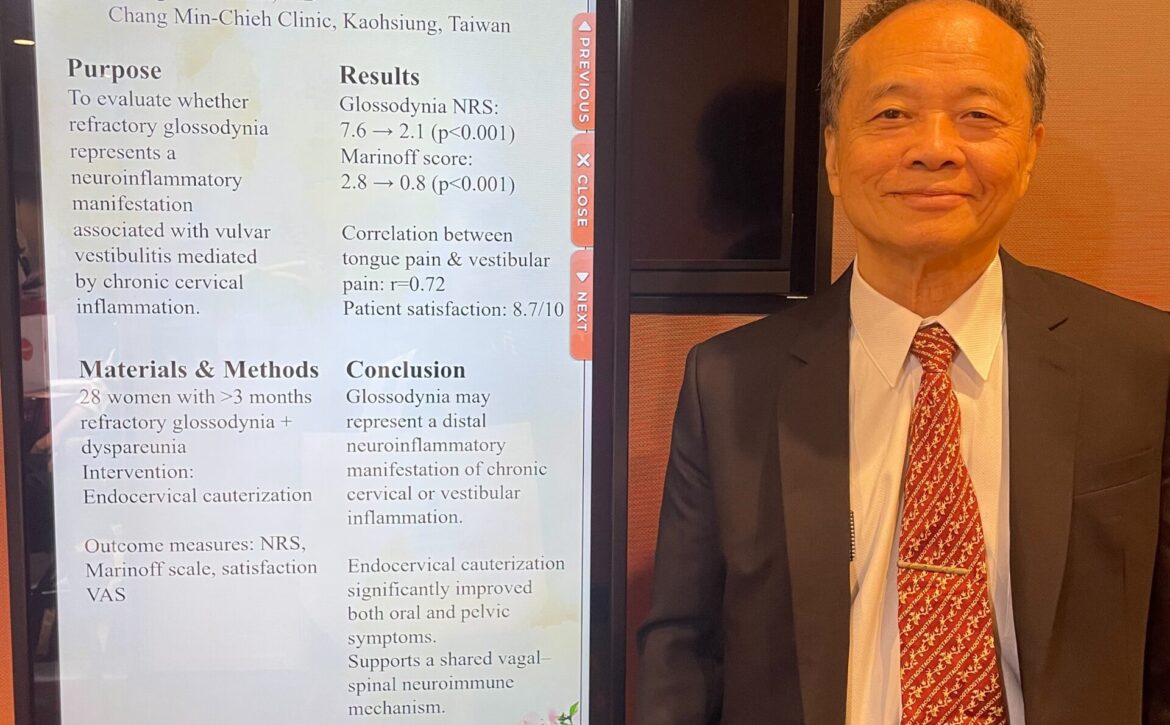
Chang Min-Chieh, MD
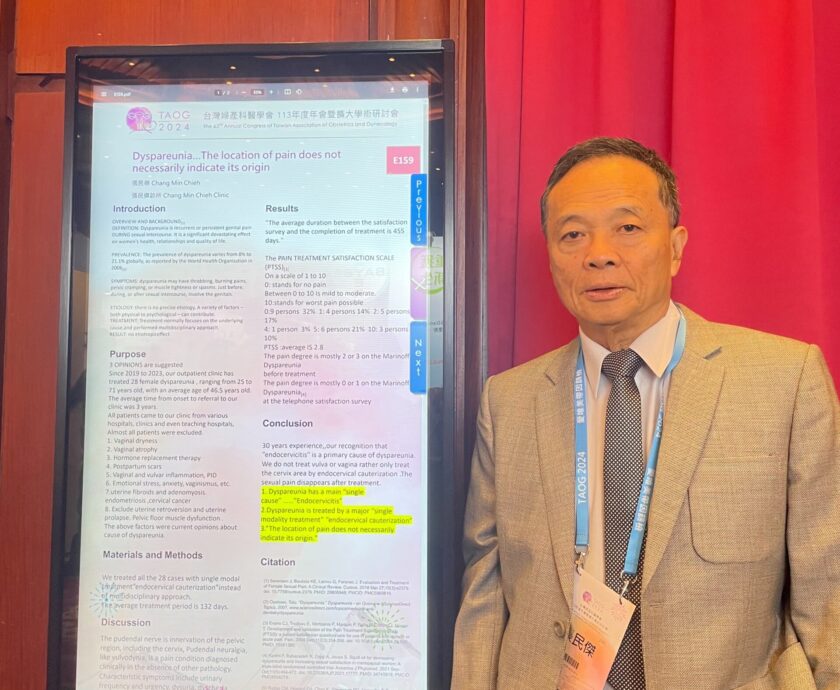
2026TAOG Taiwan Association of Obstetrics and Gynecology Academic Conference
Intractable Glossodynia Associated With Vulvar Vestibulitis: A Case Series of 28 Patients
Chang Min-Chieh, MD
Chang Min-Chieh Clinic, Kaohsiung, Taiwan
Abstract
Objective:
To investigate the potential relationship between intractable glossodynia (burning mouth syndrome) and vulvar vestibulitis (vestibulodynia), exploring whether these two seemingly distinct pain syndromes share a common neuroinflammatory pathway mediated by vagal–spinal neural convergence.
Study Design:
A retrospective observational study was conducted on 28 female patients (aged 29–68 years) who presented with chronic tongue pain refractory to conventional therapy and concurrent dyspareunia attributed to chronic cervicitis or vulvar vestibulitis. All underwent endocervical cauterization as the primary intervention. Pain scores were assessed using the Numeric Rating Scale (NRS) and Marinoff Dyspareunia Scale pre- and post-treatment.
Results:
Following cervical cauterization, mean tongue pain scores improved from 7.6 ± 1.8 to 2.1 ± 1.2 (p < 0.001). Dyspareunia improved from Marinoff grade 2.8 ± 0.6 to 0.8 ± 0.4. Patient satisfaction averaged 8.7/10. Improvement in glossodynia correlated positively with the degree of vestibular pain reduction (r = 0.72, p < 0.001).
Conclusion:
Intractable glossodynia may represent a distal manifestation of vagal-mediated neuroinflammation originating from the reproductive tract. Treatment targeting cervical or vestibular inflammation resulted in significant relief of tongue pain, suggesting a shared pathophysiological basis between vulvar vestibulitis and glossodynia.
Keywords: Glossodynia, Vulvar Vestibulitis, Dyspareunia, Vagus Nerve, Neuroinflammation
Introduction
Glossodynia (burning mouth syndrome, BMS) is a chronic oral pain disorder predominantly affecting postmenopausal women, often without visible mucosal abnormalities and resistant to conventional treatment. The etiology remains unclear, though neuropathic and inflammatory mechanisms have been proposed.
Vulvar vestibulitis (VVD), or localized provoked vestibulodynia, is likewise characterized by chronic pain and hypersensitivity of the vulvar vestibule. Increasing evidence suggests VVD is part of a broader systemic neuroinflammatory condition involving cytokine upregulation and central sensitization.
Our clinical observations indicated that many women with intractable glossodynia also suffer from vestibular pain or dyspareunia, both of which improve following treatment of chronic cervical inflammation. This study proposes a shared neuro-immune mechanism between glossodynia and VVD via dual vagal–spinal afferent convergence within the medullary solitary nucleus (NTS).
Materials and Methods
Study Population:
Between 2017 and 2025, 28 women who presented with chronic tongue pain (> 3 months) unresponsive to standard dental or neurologic therapy and concurrent dyspareunia were enrolled. All were treated at Chang Min-Chieh Clinic, Kaohsiung. Exclusion criteria included systemic diseases (diabetes, anemia), active oral infections, or psychiatric disorders.
Intervention:
Patients underwent endocervical cauterization to eliminate chronic cervical inflammatory foci previously confirmed by colposcopic findings and cytology. No direct oral or neural interventions were applied.
Assessments:
Pain intensity: NRS (0–10) for glossodynia and vestibular pain.
Sexual function: Marinoff Dyspareunia Scale.
Satisfaction: 0–10 visual analog scale.
Statistical Analysis:
Paired t-tests compared pre- and post-treatment data; correlations between tongue pain and dyspareunia improvement were analyzed by Pearson’s r. Significance was defined as p < 0.05.
Results:
Tongue Pain: Mean NRS decreased from 7.6 → 2.1 (p < 0.001).
Dyspareunia: Marinoff score improved from 2.8 → 0.8 (p < 0.001).
Correlation: Glossodynia improvement strongly correlated with vestibular pain reduction (r = 0.72, p < 0.001).
Patient satisfaction: 8.7 ± 1.1 / 10.
Discussion:
This study suggests that chronic cervical inflammation may trigger a systemic neuroinflammatory reflex via the vagal afferent–NTS–trigeminal complex axis, manifesting as distant oral pain. The co-occurrence and simultaneous improvement of glossodynia and vestibulitis support the neuro-immune convergence hypothesis.
Cytokine reduction following cervical treatment further indicates that the oral pain was secondary to a systemic inflammatory milieu rather than a localized lesion. The vagus nerve—innervating both uterine and pharyngeal–lingual regions—acts as a bidirectional immuno-sensory conduit, mediating both local and central inflammation.
This explains why glossodynia is frequently misdiagnosed as psychogenic: its origin lies not in the oral cavity but in remote neuroinflammatory signaling from the pelvic organs.
Conclusion:
Intractable glossodynia represents a neural comorbidity of vulvar vestibulitis through vagal–spinal neuroinflammatory convergence. Treating cervical or vestibular inflammation significantly reduces tongue pain, suggesting that the two conditions share an integrated autonomic and immune mechanism.
Further neuroimaging and cytokine studies are warranted to confirm this cross-organ neural–immune interaction.